LIST OF RESEARCH WORKS CARRIED OUT IN 2020-2024
R&D: project R 1.1.2 "Development of computer algorithms and a new generation of high-performance software tools for modeling and forecasting the condition and resource of critical welded structures"
Carried out within the framework of the targeted scientific research program of the NAS of Ukraine “Reliability and durability of materials, structures, equipment, and facilities (Resource-2)”, R&D codes: Stage 1 V.K.150.19.16, Stage 2 V.K.150.21.17, Stage 3 V.K.150.25.18, Stage 4 V.K.150.28.19, Stage 5 V.K.150.29.20, Q1 2016 – Q4 2020.
Results of R&D
New computer algorithms were developed for numerical forecasting of the condition of welded pipelines and pressure vessels considering nonlinear pre-critical failures, for statistical analysis of residual strength of welded pipelines and pressure vessels with detected local wall thinning defects using the Monte Carlo method.
A new generation of high-performance software tools for modeling and forecasting the condition and resource of critical welded structures based on parallel computing was developed.
Software with parallel computation organization was developed and integrated into the Weld-Predictions software suite (developed by the E.O. Paton Electric Welding Institute of the NAS of Ukraine) for solving computational problems of forecasting the load-bearing capacity of welded pipelines and pressure vessels with defects on hybrid architecture computers.
Computer solutions were obtained for a number of forecasting problems of load-bearing capacity of welded pipelines and pressure vessels with local metal loss defects considering nonlinear pre-critical failures for the E.O. Paton Electric Welding Institute of the NAS of Ukraine (significant reduction in mathematical modeling time was achieved).
The new generation of software tools for forecasting residual resource and operability of critical welded structures with detected operational defects was implemented at the E.O. Paton Electric Welding Institute of the NAS of Ukraine.
The R&D completion report was approved at the meeting of the Academic Council of the V.M. Glushkov Institute of Cybernetics of the NAS of Ukraine (Protocol dated 24.11.2020 on acceptance and evaluation of scientific work) and at the reporting session for Section 1 of the “RESOURCE-2” program on 22.12.2020.
R&D: "Develop new methods of parallel and distributed processing of very large data volumes for analysis of complex multicomponent environments"
Code V.F.K.150.20, Q1 2017 – Q4 2021.
Results of R&D
Structures of input data and properties of computational mathematics problems arising in practical tasks of analyzing complex multicomponent environments on parallel computers of various architectures were studied.
New efficient algorithms for parallel and distributed computations were developed for solving computational mathematics problems with very large data volumes arising in practical tasks of analyzing complex multicomponent environments on computers of various architectures based on automatic identification of input structure, structural regularization and decomposition of sparse data, and automatic verification of computational solution reliability.
New parallel fine-tile algorithms for solving linear algebra problems were developed, ensuring efficient use of resources of parallel computers of various architectures.
Network algorithms for processing very large data volumes for analysis of complex multicomponent environments were created.
The developed algorithmic and software tools are used for constructing optimal aerodynamic surface profiles (DP "Ilchenko-Progress") and for solving computational problems arising in modeling processes in the field of electric welding (E.O. Paton Electric Welding Institute of the NAS of Ukraine). There are no analogs of the developed algorithmic and software tools based on the developed methodology in the field of electric welding.
The R&D completion report was approved at the meeting of the Academic Council of the V.M. Glushkov Institute of Cybernetics of the NAS of Ukraine (Protocol No. 20 dated 07.12.2021 on acceptance and evaluation of scientific work).
R&D: "Develop an intelligent computer mathematics system for solving computational problems of mathematical modeling in science and engineering on hybrid architecture computers"
Code V.P.150.22, Q1 2018 – Q4 2020.
Results of R&D
Principles and methodology for computer research of mathematical models with approximate data were developed, implementing automatic adaptive tuning of the method, algorithm, and parallel computer topology according to problem properties.
An intelligent computer mathematics system (ICMS) was developed for automatic research and solving computational mathematics problems on computers with multicore and graphical processors based on the use of artificial intelligence elements and multi-precision arithmetic to ensure solution reliability.
InparSolver (an experimental ICMS prototype) was created and implemented as standard software for the SKIT supercomputer complex.
InparSolver is used in NAS Institutes of Ukraine (E.O. Paton Electric Welding Institute, S.P. Timoshenko Institute of Mechanics). Using InparSolver significantly increases user productivity and reduces time and resources for conducting physical experiments. There are no analogs of the ICMS InparSolver worldwide.
The R&D completion report was approved at the meeting of the Academic Council of the V.M. Glushkov Institute of Cybernetics of the NAS of Ukraine (Protocol No. 4 dated 24.11.2020 on acceptance and evaluation of scientific work).
R&D performed under contract: "Develop methods of high-performance computing for studying mathematical models of heterogeneous media and processing big data based on supercomputer technologies"
Code 7/2/267-10df / V.F.150.2.1230, Q1 2020 – Q4 2021.
Results of R&D
New adaptive computer methods and high-performance computing algorithms were developed for solving computational problems arising in mathematical modeling of the state of heterogeneous media and processes occurring within them.
New discrete mathematical models of the state of heterogeneous media and processes occurring within them were created, including fractional differential models for studying features of migration dynamics of soluble substances during groundwater filtration.
A promising architecture of specialized segments of a computing cluster for training and applying artificial neural networks was developed.
The proposed methods and computer algorithms were experimentally studied by solving a number of test and practical problems. The created methods and algorithms are used in NAS Institutes of Ukraine (E.O. Paton Electric Welding Institute, S.P. Timoshenko Institute of Mechanics) for mathematical modeling of the state of heterogeneous media and processes occurring within them.
The R&D completion report was approved at the meeting of the Academic Council of the V.M. Glushkov Institute of Cybernetics of the NAS of Ukraine (Protocol No. 20 dated 07.12.2021 on acceptance and evaluation of scientific work).
R&D: "Develop models and methods of heterogeneous computing for continuum mechanics problems"
Code V.F.150.26, Q1 2019 – Q4 2023.
Results of R&D
New models and methods of heterogeneous computing were developed, using a combination of MIMD and SIMD architectures, simultaneous use of different types and levels of memory, arbitrary precision, block processing of sparse data, multithreading, and software modules created by processor and graphics accelerator manufacturers.
New methods and algorithms for studying and solving basic computational mathematics problems with approximate data on heterogeneous computer systems with variable hardware and software were developed.
Methods of structural regularization of matrices for computational problems were developed; architecture and training of a convolutional neural network for automatic computer identification of structures and characteristics of sparse matrices were conducted.
Theoretical foundations and new block algorithms for high-performance computing using multi-precision and mixed-precision arithmetic for studying and solving linear algebra problems and systems of nonlinear equations on heterogeneous computers were developed.
A methodology for high-performance computing for studying and calculating mathematical models described by problems with a unique solution in a subspace, using the normal pseudoinverse solution of SLAE of discrete finite element models, was developed and substantiated.
New methods and computer algorithms of high-performance computing for studying and solving computational problems of continuum mechanics in a variable hardware and software environment of heterogeneous computers were developed: strength and stability analysis of structures, including composite materials, modeling and forecasting the condition and resource of critical welded structures, modeling heat transfer processes.
The developed methods and algorithms are applied to solve practical problems of continuum mechanics on modern high-performance computers for restoration and reconstruction of damaged or destroyed objects of military and civil infrastructure, primarily critical infrastructure, in defense, mechanical engineering, construction, and natural resource sectors. The developed algorithmic and software tools are used in NAS Institutes of Ukraine: V.M. Glushkov Institute of Cybernetics, E.O. Paton Electric Welding Institute, S.P. Timoshenko Institute of Mechanics.
The R&D completion report was approved at the meeting of the Academic Council of the V.M. Glushkov Institute of Cybernetics of the NAS of Ukraine (Protocol No. 18 dated 28.11.2023 on acceptance and evaluation of scientific work).
R&D "Develop adaptive algorithms of high-performance computing for mathematical modeling of physico-technical processes in a variable computer environment"
Code No. 8.22 MM / VKM 150.35.22, Q1 2021 – Q4 2023.
Results of R&D.
Algorithmic and software tools were developed for researching and solving linear algebra problems with sparse data structures, which enable automatic selection of the most efficient variable computer environment for solving a specific problem, as well as transforming matrices into one of the canonical forms (banded, skyscraper, profile, block-diagonal with framing) and applying efficient decomposition methods. The use of the created algorithmic and software tools significantly increases computational performance in mathematical modeling with very large systems of linear equations and algebraic eigenvalue problems (up to tens of millions) and provides numerical results with higher reliability. Used for mathematical modeling of stress-strain state, natural frequencies, and stability of building structures and their elements.
R&D "Develop an intelligent interface for modeling physico-mechanical processes based on parallel computing"
Code V.P.150.30, Q1 2022 – Q4 2024.
Results of R&D
An intelligent interface for automatic mathematical modeling (IIMM) of physico-mechanical processes with approximate data of very large volumes was developed and tested on the SKIT cluster complex, performing mathematical modeling of physico-mechanical processes: condition of critical welded structures; strength of building structures; stability of new composite materials, etc.
For testing IIMM, lifecycle computational models of welded structures, strength of building structures and facilities, and stability of composite materials were constructed. Using IIMM, on a hybrid computer, automatic research of a computational model with a priori uncertain properties is performed, and an efficient solution algorithm is built in a variable computer environment—the most effective for the specific computational model. Upon completion of computations, the obtained solution is provided with reliability estimates and explanations of the research process. For such research, IIMM uses knowledge-oriented technologies based on artificial intelligence methods, machine methods for research and solving problems with approximate data, employing multi-precision and mixed computation models on parallel, distributed, and hybrid architecture computers. As a result of using IIMM, users gain new knowledge about the mathematical properties of the computational model. By comparing obtained results with existing knowledge about the physico-mechanical object, applied users can identify shortcomings of the initial problem formulation, constructed mathematical model, etc., and warn against unforeseen catastrophes.
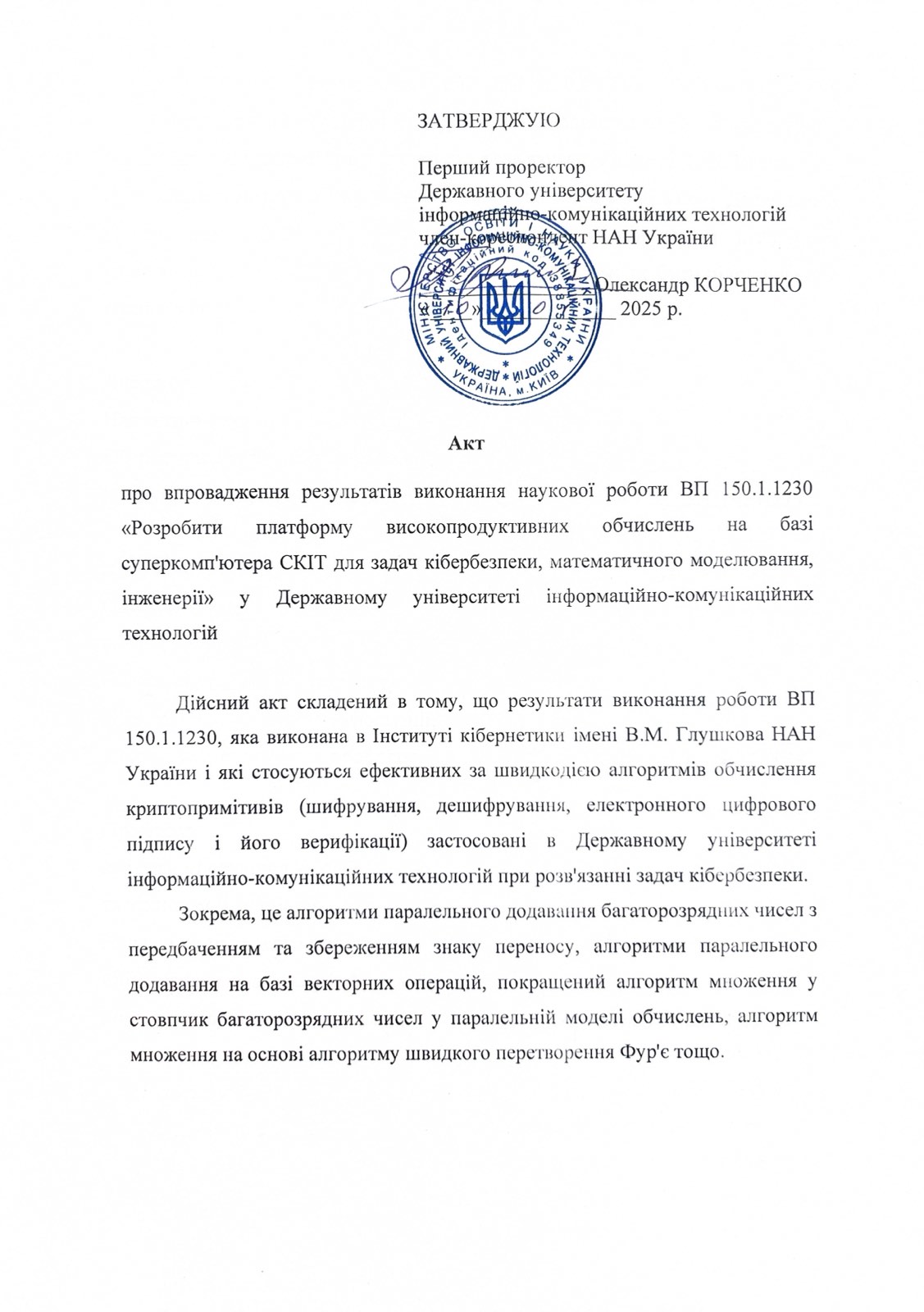
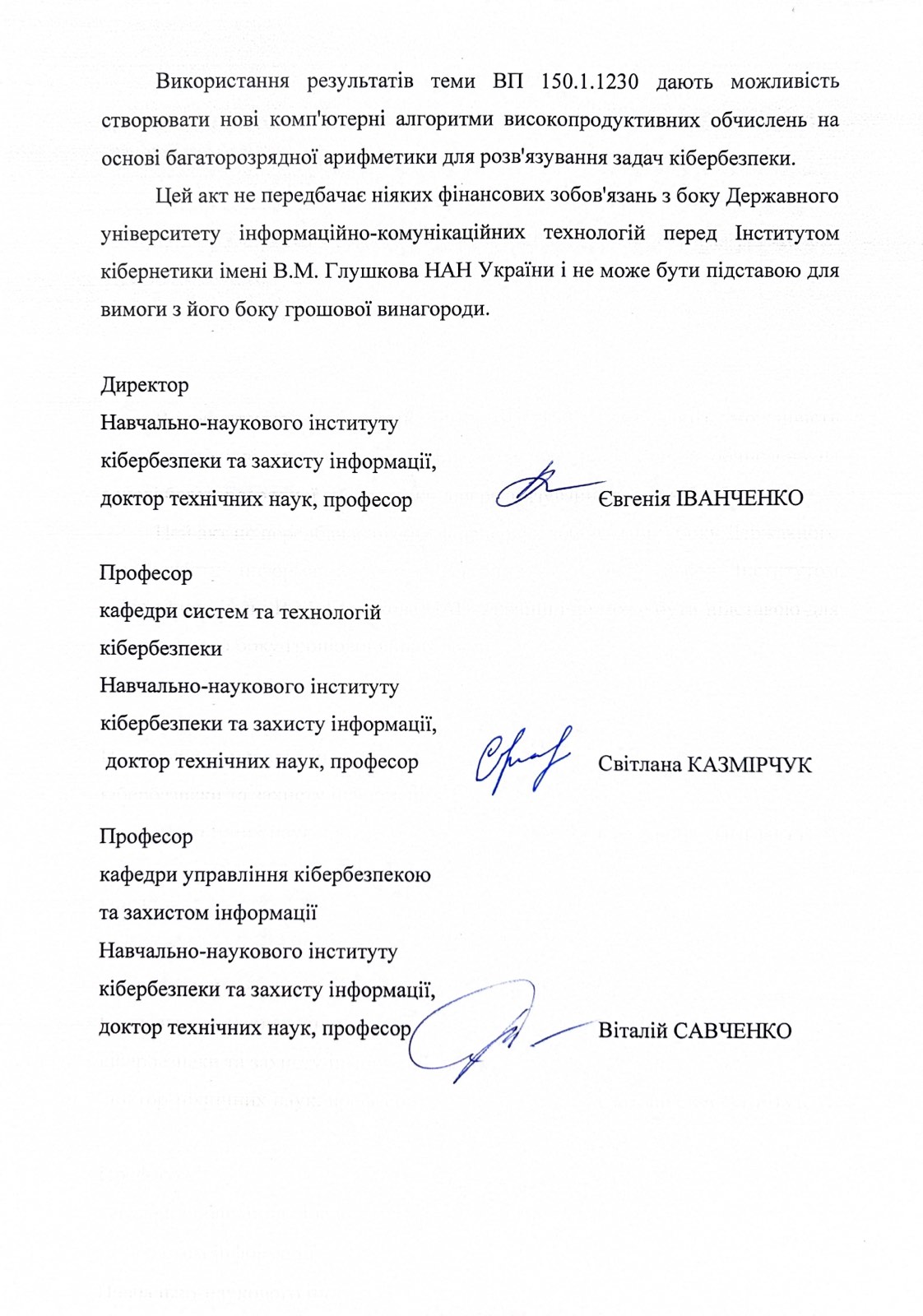
R&D performed under contract: "Develop a high-performance computing platform based on the SKIT supercomputer for cybersecurity, mathematical modeling, and engineering tasks"
Code V.P.150.4.1230, Q1 2023 – Q4 2024.
Results of R&D
In the Act dated December 31, 2024, of acceptance of the scientific project "Develop a high-performance computing platform based on the SKIT supercomputer for cybersecurity, mathematical modeling, and engineering tasks" for Stage II "Create a high-performance computing platform for solving mathematical modeling, discrete optimization, crypto- and steganalysis problems, and vulnerability detection based on SKIT supercomputers and conduct testing on test and practical tasks," performed according to the NAS of Ukraine Presidium resolution dated 13.12.2023 No. 443 "On budget financing of NAS of Ukraine in 2024" and Contract dated 01.01.2024 No. 2.1/24-P. Execution period: start January 1, 2024; end December 31, 2024, the following was noted:
A new generation of parallel and distributed computing algorithms was developed for mathematical modeling of objects, processes, and phenomena of various nature, discrete optimization, cryptanalysis, and vulnerability detection in software and hardware.
New block methods and adaptive computer algorithms of high-performance computing were developed for solving computational problems based on multi-precision and mixed-precision arithmetic arising in modeling objects, processes, and phenomena of various nature.
A two-dimensional fractional differential spatial non-isothermal moisture transfer model based on a linearized finite-difference scheme was constructed, and a multithreaded algorithm with dynamic time step adjustment was developed for solving initial-boundary value problems based on analysis of the required number of iterations for solving SLAE and its speed estimates.
Methods for organizing parallel work of portfolios of optimization algorithms based on modern multiprocessor computing complexes and advanced software technologies were developed.
A systematic approach to stability analysis and regularization of vector optimization problems under uncertainty and possible disturbances of input data using Pareto optimization was developed.
Methods and algorithms of high-performance computing for parallel and quantum computation models based on multi-precision arithmetic were developed for solving cryptanalysis problems in cybersecurity.
Behavior algebra templates were created and an algebraic matching algorithm for Intel x86 binary assembler code was implemented based on an insertion modeling system.
The report on the completion of Stage II of the scientific project was approved at the meeting of the Academic Council of the V.M. Glushkov Institute of Cybernetics of the NAS of Ukraine (protocol dated 26.11.2024 No. 18).
INTERNATIONAL SCIENTIFIC PROJECT
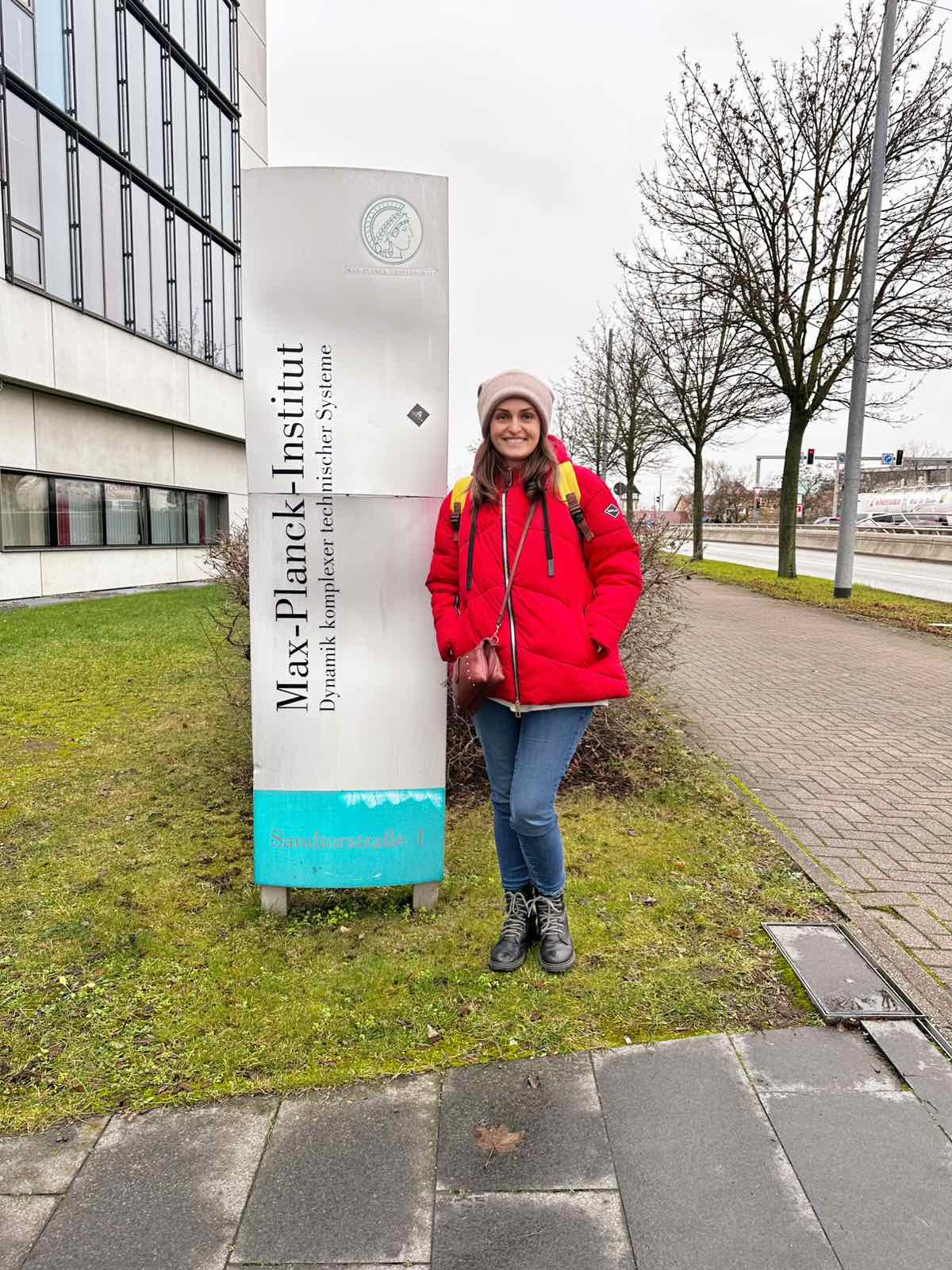
One of the important activities of the department is international cooperation. A team of young researchers from the department conducts scientific research under the International EIRENE Max Planck — Ukraine Cooperation & Mobility Grant program from the Max Planck Society (Germany). The research concerns sparse data structures in the context of high-performance computing (HPC) for solving linear algebra problems — adaptive algorithms and technologies. https://www.old.nas.gov.ua/UA/Messages/Pages/View.aspx?MessageID=10515, https://ukrainet.eu/2022/05/06/mps-ukraine/
In the Information-Analytical Bulletin No. 8, 2023 "Ways of Development of Ukrainian Science" (Supplement to the journal "Ukraine: Events, Facts, Comments") in the section "International Partnership for Ensuring the Sustainability of Science and Education in Ukraine," page 26, information is provided: "The team of young researchers of the V.M. Glushkov Institute of Cybernetics of the NAS of Ukraine was nominated for a grant under the EIRENE Max Planck-Ukraine Cooperation & Mobility Grant program from the Max Planck Society (Germany)," https://ukrainet.eu/2022/05/06/mps-ukraine/ https://nbuviap.gov.ua/images/informaciyni_vidanya/shliahi_rozv_nauki/2023/nauka08.2023.pdf
PROMOTION OF WIDE USE OF RESULTS BY THE SCIENTIFIC AND EDUCATIONAL COMMUNITY
Presentations at the 4th International Workshop of IT-professionals on Artificial Intelligence.
Articles in publications indexed in international scientometric databases Scopus and Web of Science.
Teaching at higher education institutions
Academician, Doctor of Physical and Mathematical Sciences, Professor O.M. Khimich taught special courses at NTUU "Igor Sikorsky Kyiv Polytechnic Institute" in 2018–2021: "Methods of Parallel and Distributed Computing," "Grid Systems and Cloud Computing Technologies"; https://intellect.kpi.ua/profile/xom2; since 2018, he has been teaching at Taras Shevchenko National University special courses: "Methods of Computer Research of Mathematical Models," "Methods of Parallel and Distributed Computing." https://incyb.kiev.ua/employee/khimich-oleksandr-mykolayovych, https://csc.knu.ua/uk/person/khimich
Senior researcher, Candidate of Physical and Mathematical Sciences teaches a special course "High-Performance Distributed Computing Systems" at Kamianets-Podilskyi University https://cs.kpnu.edu.ua/2024/09/19/sydoruk-volodymyr-anatolijoch/
RECOGNITION OF SCIENTIFIC ACHIEVEMENTS
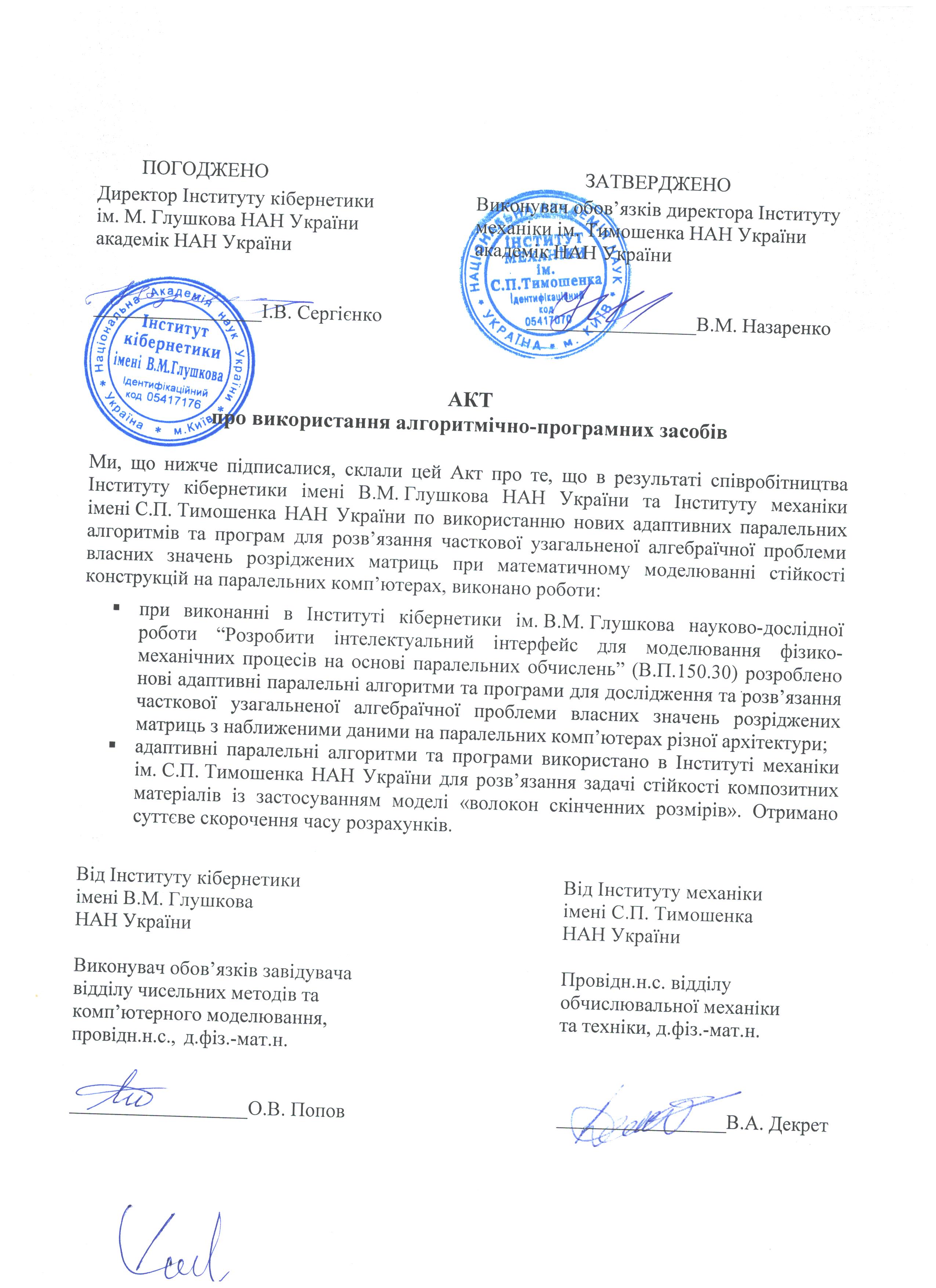
Acts on the use of scientific developments have been obtained:
For the scientific work "Modeling of physico-technical processes based on parallel computing," V.A. Sydoruk and O.V. Chistyakov were awarded the President of Ukraine Prize for young scientists: Presidential Decree of Ukraine No. 595 / 2020 dated December 29, 2020. https://www.old.nas.gov.ua/UA/Messages/Pages/View.aspx?MessageID=7333
SCIENCE-BUSINESS CONNECTION
The GrantsForScience platform based on artificial intelligence technologies for cooperation between science and business. Grants for Science is a modern platform that creates a bridge between science and business. The platform provides personalized search for grant programs, partners, performers, allows creating consortia and managing projects, simplifying interaction among all participants.
Project description
Platform link: https://www.grantsforscience.com/
Scientific publications:
Oleksandr M. Khimich, Serhii V. Yershov, Elena A. Nikolaevskaya, Pavlo S. Yershov Development of an Intelligent Search System using GPT model for GrantsForScience platform. ProfIT AI 2024: 4th International Workshop of IT-professionals on Artificial Intelligence (ProfIT AI 2024), September 25–27, 2024, Cambridge, MA, USA. Vol-3777. P. 111-119 https://ceur-ws.org/Vol-3777/short3.pdf
Presentation videos: