
- Home
- Subdivisions
- People
- Nikolaievska Olena Anatoliivna

Nikolaievska Olena Anatoliivna
Candidate (PhD) of Physical and Mathematical Sciences, Senior Researcher
Biography
Nikolaevska Olena Anatoliivna, born in 1983, has been working at the VM Glushkov Institute of Cybernetics of the National Academy of Sciences of Ukraine since 2008. As a software engineer since May 2008, since November 2008 she has been transferred to the position of junior researcher, as a researcher since 2011, from 2020 to the present she has been transferred to the position of senior researcher .
Specialty by diploma - "Mathematics and Fundamentals of Economics".
In 2010 she successfully defended her dissertation on specialty 01.05.02 - "Mathematical modeling and computational methods".
Scientific bases



Research interests
- Least squares problem, weighted least squares problem, weighted pseudo-inverse matrix of Moore-Penrose;
- methods and algorithms for solution SLAE with approximate initial data, singular value decomposition of the matrix, weighted singular value decomposition of the matrix;
- mathematical models with approximate initial data;
- algorithms for solution SLAE for computers with parallel architecture;
- programming with multiple precision, GMP, MPFR
- machine learning, AI, GPT models
Main results
- perturbation theory and error theory for weighted least squares problems are developed;
- the errors of the weighted normal pseudoresolution in the case of mismatch of the rank of the original and perturbed matrix are obtained;
- an original approach to proving the existence and uniqueness of a normal pseudo-solution in the case of a problem with positively determined weights is proposed;
- developed algorithms for solving problems of weighted least squares with positively determined weights with matrices of arbitrary structure and arbitrary rank on computers of MIMD-architecture using arbitrary bit size;
- a study of the dependence of the efficiency of algorithms on the decomposition of the original data in solving these problems, as well as on the structure and architecture of MIMD-computers.
- Khimich A.N., Nikolaevskaya E.A., Baranov I.A. Weighted least squares perturbation theory. "Matrix Theory - Classics and Advances" edited by Dr. Mykhaylo Andriychuk, 2022, ISBN 978-1-80355-823-3, DOI: https://doi.org/10.5772/intechopen.102885
- Nikolaevskaya E.A., Khimich A.N., Chistyakova T.V. Programming with Multiple Precision. - Springer; 1st edition (February 2, 2012)
2026
- Oleksandr M. Khimich, Elena A. Nikolaevskaya, Pavlo S.Yershov Development of a Virtual Travel Assistant using the GPTModel. A Springer book series: Smart Innovation,Systems and Technologies. ICT for Intelligent SystemsProceedings of ICTIS 2025, Volume 14, 2026, pp 87–101 DOI: 10.1007/978-981-95-1361-1_7
Khimich, O., Popov, O., Nikolaevskaya, E., Sydoruk, V. Solving Eigenvalue Problems for Skyscraper and Bordered Block-Diagonal Matrices, Numerische Mathematik, 2026
Khimich, O., Popov, O., Nikolaevskaya, E., Sydoruk, V. Development of adaptive algorithms for determining mathematical properties of SLAE and AEP problems based on multi-precision arithmetic, Numerical Linear Algebra with Applications, 2026
2025
- Oleksandr M. Khimich, Oleksandr V. Popov, Tamara V. Chistyakova, Elena A. Nikolaevskaya, Pavlo S. Yershov, AI-based Intelligent System for Applied problems: conception and architecture. 2025 IEEE 8th International Conference on Methods and Systems of Navigation and Motion Control (MSNMC) October 21-24, 2025, Kyiv, Ukraine
- Oleksandr M. Khimich, Oleksandr V. Popov, Tamara V. Chistyakova, Elena A. Nikolaevskaya, Pavlo S. Yershov, AI-based Intelligent System for Applied problems: Model Generation Web Application Architecture. ProfIT AI 2025: 5th International Workshop of IT-professionals on Artificial Intelligence (ProfIT AI 2025), October 15-17, 2025, Liverpool, UK. Vol-4164 p 250-261
Sydoruk V., Chystiakov O., Benner P., Nikolaievska O. Solving Linear Systems of Equations with Block Skyscraper Structure. Cybernetics and Computer Technologies. 2025. 3. P. 68–78. https://doi.org/10.34229/2707-451X.25.3.6 http://cctech.org.ua/images/docs/Articles/2025/paper_25_3_6.pdf
Oleksandr Khimich, Oleksandr Popov, Elena Nikolaevskaya, Volodymyr Sydoruk Solving incorrect problems in conditions of approximate data with singular matrices. CompCom 2025, Lecture Notes in Networks and Systems 1425, pp. 1–15, 2025. https://doi.org/10.1007/978-3-031-92608-2_21
- Zahorodniy, A. H., Khimich, O. M., Andon, P. I., Dubrovinа, L. A., Radchenko, A. I., Zhuk, O. M., Didenko, Yu. V., Svistunov, S. Ya., Shadura, V. M., Tulchynskyi, V. H., Horbachuk, V. M., Nikolaevska, O. A., Kolomiiets, O. V., Haragulia, S. S., Symonenko, T. V., Zaika, V. M., Novytskyi, O. V., Proskudina, H. Yu., Reznichenko, V. A., Kapitsa, Yu. M., Chernovska, S. M., & Shakhbazyan, K. S. (2025). Implementation of European principles of open science in the National Academy of Sciences of Ukraine. Visnik Nacional Noi Academii Nauk Ukrai Ni, (1), 11–33. https://doi.org/10.15407/visn2025.01.011
2024
- Oleksandr M. Khimich, Serhii V. Yershov, Elena A. Nikolaevskaya, Pavlo S. Yershov Development of an Intelligent Search System using GPT model for GrantsForScience platform. ProfIT AI 2024: 4th International Workshop of IT-professionals on Artificial Intelligence (ProfIT AI 2024), September 25–27,2024, Cambridge, MA, USA. Vol-3777. P. 111-119. + Video
2023
- Khimich O., Nikolaevska O., & Baranov I. (2023). Features of the use of multi-digit arithmetic in mathematical modeling. PHYSICO-MATHEMATICAL MODELING AND INFORMATION TECHNOLOGIES, (37), 143-148.
DOI: https://doi.org/10.15407/10.15407/fmmit2023.37.143
URL: http://www.fmmit.lviv.ua/index.php/fmmit/article/view/322
2020
- Khimich A.N., Nikolaevskaya E.A. Existence and uniqueness of weighted normal pseudosolution // Cybernetics and Systems Analysis, 2020, Vol. 56, No. 4, pp. 28-34.
Khimich A.N., Nikolaevskaya E.A. Existence and Uniqueness of Weighted Normal Pseudosolutions. Cybern Syst Anal 56, 544–549 (2020).
DOI: https://doi.org/10.1007/s10559-020-00270-5
URL: http://www.kibernetika.org/volumes/2020/numbers/04/articles/03/ArticleDetailsUA.html
2017
- Khimich O.M., Nikolaevska O.A., Chistyakova T.V. On some methods to improve the accuracy of computer calculations // Mathematical and Computer Modeling. Series: Physical and Mathematical Sciences. Collection of scientific works / V.M. Glushkov Institute of Cybernetics of the NAS of Ukraine, Kamianets-Podilskyi National University named after I. Ohienko, 2017, issue 15, pp. 249–254.
DOI: https: // doi.org/10.32626/2308-5878.2017-15.249-254
URL: http://mcm-math.kpnu.edu.ua/article/view/111630
2016
- Khimich O.M., Nikolaevska O.A., Chistyakova T.V. On the algorithm of the least squares method for solving linear systems on hybrid computers // Computer Mathematics, 2016, No. 2, pp. 120−128.
URL: http://dspace.nbuv.gov.ua/handle/123456789/168425
2009
- Nikolaevskaya E.A., Khimich A.N., Yakovlev M.F. Solution of the weighted least squares problem with a symmetric positive semi-definite matrix // Computer Mathematics. – 2009. – No. 3. – pp. 36 – 45.
- Nikolaevskaya E.A., Chistyakova T.V. Program-algorithmic methods to improve the accuracy of computer solutions // Cybernetics and Systems Analysis. – 2009. – No. 6. – pp. 172 – 176.
Nikolaevskaya E.A., Chistyakova T.V., Program-algorithmic methods to improve the accuracy of computer solutions Cybernetics and Systems Analysis (2009) 45(6) 1004-1007
DOI: 10.1007/s10559-009-9164-7 - Nikolaevskaya E.A., Khimich A.N. Error estimation of weighted normal pseudosolution with positive definite weights // Journal of Computational Mathematics and Mathematical Physics. – 2009. – Vol. 49, No. 3. – pp. 422 – 430.
Khimich A.N., Nikolaevskaya E.A., Error estimation for a weighted minimum-norm least squares solution with positive definite weights // Computational Mathematics and Mathematical Physics (2009) 49(3) 409-417
DOI: 10.1134/S0965542509030038
2008
- Khimich A.N., Nikolaevskaya E.A. Solution of the weighted least squares problem with approximately given initial data // Collection of scientific works. Theory of optimal solutions. Kyiv: V.M. Glushkov Institute of Cybernetics of the NAS of Ukraine. – 2008. – No. 7. – pp. 132 – 139.
- Khimich A.N., Nikolaevskaya E.A. Analysis of the reliability of computer solutions of systems of linear algebraic equations with approximately given initial data // Cybernetics and Systems Analysis.– 2008. – No. 6. – pp. 83 – 95.
Khimich A.N., Nikolaevskaya E.A. Reliability analysis of computer solutions of systems of linear algebraic equations with approximate initial data Cybernetics and Systems Analysis (2008) 44(6) 863-874
DOI: 10.1007/s10559-008-9062-4
2007
- Khimich A.N., Nikolaevskaya E.A. Perturbation analysis of the solution of the weighted least squares problem. // Collection of scientific works. Theory of optimal solutions. Kyiv: V.M. Glushkov Institute of Cybernetics of the NAS of Ukraine. – 2007. – No. 6. – pp. 12 – 18.
2006
- Khimich A.N., Nikolaevskaya E.A. Error estimation of the solution of the weighted least squares problem // Collection of scientific works. Computer Mathematics. Kyiv: V.M. Glushkov Institute of Cybernetics of the NAS of Ukraine. – 2006. – No. 3. – pp. 36 – 45.
Scopus page: https://www.scopus.com/authid/detail.uri?authorId=6503942582
ORCID: https://orcid.org/0000-0002-5145-0189
Web of Science: https://www.webofscience.com/wos/author/record/KII-6532-2024
2026
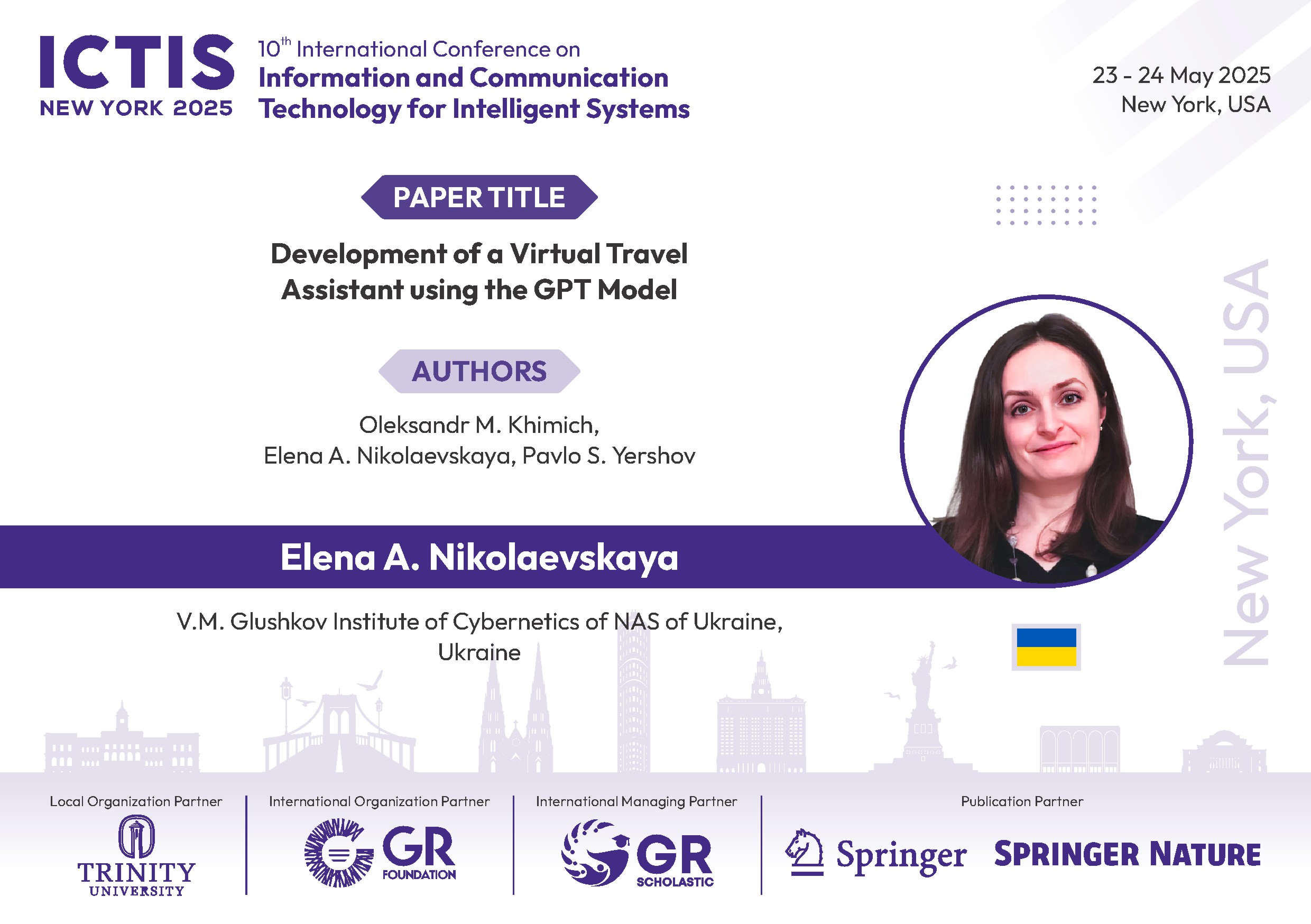
- Oleksandr M. Khimich, Elena A. Nikolaevskaya, Pavlo S.Yershov Development of a Virtual Travel Assistant using the GPTModel. A Springer book series: Smart Innovation,Systems and Technologies. ICT for Intelligent SystemsProceedings of ICTIS 2025, Volume 14, 2026, pp 87–101 DOI: 10.1007/978-981-95-1361-1_7 (English) + Contribution Certificate + Presentation Certificate + Presenter Flyer + Thank You Letter + Video
Khimich, O., Popov, O., Nikolaevskaya, E., Sydoruk, V. Solving Eigenvalue Problems for Skyscraper and Bordered Block-Diagonal Matrices, Numerische Mathematik, 2026
Khimich, O., Popov, O., Nikolaevskaya, E., Sydoruk, V. Development of adaptive algorithms for determining mathematical properties of SLAE and AEP problems based on multi-precision arithmetic, Numerical Linear Algebra with Applications, 2026
2025
- Oleksandr M. Khimich, Oleksandr V. Popov, Tamara V. Chistyakova, Elena A. Nikolaevskaya, Pavlo S. Yershov, AI-based Intelligent System for Applied problems: conseption and architecture. 2025 IEEE 8th International Conference on Methods and Systems of Navigation and Motion Control (MSNMC) October 21-24, 2025, Kyiv, Ukraine
- Oleksandr M. Khimich, Oleksandr V. Popov, Tamara V. Chistyakova, Elena A. Nikolaevskaya, Pavlo S. Yershov, AI-based Intelligent System for Applied problems: Model Generation Web Application Architecture. ProfIT AI 2025: 5th International Workshop of IT-professionals on Artificial Intelligence (ProfIT AI 2025), October 15-17, 2025, Liverpool, UK. Vol-4164 p 250-261
- Oleksandr Khimich, Oleksandr Popov, Elena Nikolaevskaya, Volodymyr Sydoruk Solving incorrect problems in conditions of approximate data with singular matrices. CompCom 2025, Lecture Notes in Networks and Systems 1425, pp. 1–15, 2025. https://doi.org/10.1007/978-3-031-92608-2_21 ( English)
2024
- Oleksandr M. Khimich, Serhii V. Yershov, Elena A. Nikolaevskaya, Pavlo S. Yershov Development of an Intelligent Search System using GPT model for GrantsForScience platform. ProfIT AI 2024: 4th International Workshop of IT-professionals on Artificial Intelligence (ProfIT AI 2024), September 25–27,2024, Cambridge, MA, USA. Vol-3777. P. 111-119. ( English) + Video
2020
- Khimich A.N., Nikolaevskaya E.A. Existence and Uniqueness of Weighted Normal Pseudosolutions // Cybernetics and Systems Analysis, 56, 544–549 (2020). DOI: https://doi.org/10.1007/s10559-020-00270-5
2012
- Nikolaevskaya, E.A., Khimich, A.N., Chistyakova, T.V. Why does the precision improve? Studies in Computational Intelligence, 2012, V. 397, P. 3–12, DOI: 10.1007/978-3-642-25673-8-1
- Nikolaevskaya, E.A., Khimich, A.N., Chistyakova, T.V. About GMP. Studies in Computational Intelligence, 2012, 397, P. 13–30 DOI: 10.1007/978-3-642-25673-8-2
- Nikolaevskaya, E.A., Khimich, A.N., Chistyakova, T.V. Solution of linear algebraic equations by Gauss method. Studies in Computational Intelligence, 2012, 397, страницы 31–44. DOI: 10.1007/978-3-642-25673-8-3
- Nikolaevskaya, E.A., Khimich, A.N., Chistyakova, T.V. What is MPFR? Studies in Computational Intelligence, 2012, 397, страницы 45–70. DOI: 10.1007/978-3-642-25673-8-4
- Nikolaevskaya, E.A., Khimich, A.N., Chistyakova, T.V. GMP for C++ Studies in Computational Intelligence, 2012, 397, страницы 71–96. DOI: 10.1007/978-3-642-25673-8-5
- Nikolaevskaya, E.A., Khimich, A.N., Chistyakova, T.V. Parallel calculations using MPI Studies in Computational Intelligence, 2012, 397, страницы 99–121. DOI: 10.1007/978-3-642-25673-8-6
- Nikolaevskaya, E.A., Kouya, T., Khimich, A.N., Chistyakova, T.V. MPIBNCpack library. Studies in Computational Intelligence, 2012, 397, страницы 123–134. DOI: 10.1007/978-3-642-25673-8-7
- Nikolaevskaya, E.A., Khimich, A.N., Chistyakova, T.V., Polyanko, V.V. Parallel method for solution SLAE with multiple precision. Studies in Computational Intelligence, 2012, 397, страницы 135–209. DOI: 10.1007/978-3-642-25673-8-8
2009
- Nikolaevskaya E.A., Chistyakova T.V., Program-algorithmic methods to improve the accuracy of computer solutions // Cybernetics and Systems Analysis (2009) 45(6) 1004-1007. DOI: 10.1007/s10559-009-9164-7
- Khimich A.N., Nikolaevskaya E.A., Error estimation for a weighted minimum-norm least squares solution with positive definite weights // Computational Mathematics and Mathematical Physics (2009) 49(3) 409-417. DOI: 10.1134/S0965542509030038
2008
- Khimich A.N., Nikolaevskaya E.A. Reliability analysis of computer solutions of systems of linear algebraic equations with approximate initial data // Cybernetics and Systems Analysis (2008) 44(6) 863-874. DOI: 10.1007/s10559-008-9062-4
2025
- Oleksandr Khimich, Oleksandr Popov, Elena Nikolaevskaya, Volodymyr Sydoruk Solving incorrect problems in conditions of approximate data with singular matrices. Computing Conference 2025, 19 & 20 June 2025 in London, United Kingdom.
- Oleksandr M. Khimich, Oleksandr V. Popov, Tamara V. Chistyakova, Elena A. Nikolaevskaya, Pavlo S. Yershov, AI-based Intelligent System for Applied problems: Model Generation Web Application Architecture. ProfIT AI 2025: 5th International Workshop of IT-professionals on Artificial Intelligence (ProfIT AI 2025), October 15-17, 2025, Liverpool, UK. Vol-4164 p 250-261 + Certificate
- Oleksandr M. Khimich, Elena A. Nikolaevskaya, Pavlo S.Yershov Development of a Virtual Travel Assistant using the GPTModel. A Springer book series: Smart Innovation,Systems and Technologies. ICT for Intelligent SystemsProceedings of ICTIS 2025, Volume 14, 2026, pp 87–101 DOI: 10.1007/978-981-95-1361-1_7 The 10th International Conference on ICT for Intelligent Systems (ICTIS - 2025), 23 - 24 May, 2025, New York, USA + Contribution Certificate + Presentation Certificate + Presenter Flyer + Thank You Letter + Video
2024
2023
- Хіміч О.М., Ніколаєвська О.А., Баранов І.А. Особливості застосування багаторозрядної арифметики в математичному моделюванні // Праці Міжнародного наукового симпозіуму “Питання оптимізації обчислень (ПОО-XLVІІІ)”, присвяченого 100-річчю від дня народження академіка В.М. Глушкова, м. Київ, м. Львів, м. Харків, 19 - 22 вересня 2023 р., ФІЗИКО-МАТЕМАТИЧНЕ МОДЕЛЮВАННЯ ТА ІНФОРМАЦІЙНІ ТЕХНОЛОГІЇ, (37), 143-148.
- Хіміч О.М., Ніколаєвська О.А. Багаторозрядна арифметика як інструмент для отримання достовірних розв’язків задач // Праці Міжнародної наукової конференції "Актуальні проблеми механіки - 2023" до145-річчя від дня народження С.П.Тимошенка, м. Київ, м Дніпро, м. Львів, м. Харків, 14−16 листопала 2023 р, С. .
2022
- Горбачук Василь, Гавриленко Сергій, Голоцуков Геннадій, Ніколаєвська Олена. Ніколенко Дмитро, Пустовойт Михайло Інфраструктурні технології великих і відкритих даних НАН України // Перша міжнародна конференція «Відкрита наука та інновації в Україні 2022», м. Київ, 27-28 жовтня 2022 року, DOI: 10.35668/978-966-479-129-5-4-4
Vasyl Gorbachuk; Serge Gavrilenko; Gennady Golotsukov; Olena Nikolaevska; Dmytro Nikolenko; Mykhailo Pustovoit Infrastructural technologies of big and open data of the National academy of sciences of Ukraine // The first international conference "Open science and innovation in Ukraine 2022", Kyiv, October 27-28, 2022, DOI: 10.35668/978-966-479-129-5-4-4
2016
- Хіміч О.М., Ніколаєвська О.А., Чистякова Т.В. Про деякий алгоритм розв’язування лінійних систем на гібридних комп’ютерах //Праці XXII Всеукраїнської наукової конференції «Сучасні проблеми прикладної математики та інформатики (APAMCS-2016)», м. Львів, 5−7 жовтня 2016 р., С. 191−194.
URL: http://apamcs.lnu.edu.ua/tmp/APAMCS-2016.pdf
2015
- Хіміч О.М., НіколаєвськаО.А., Чистякова Т.В. Про достовірність комп’ютерних розв’язків погано обумовлених лінійних систем // Матеріали Міжнародної школи-семінару «Питання оптимізації обчислень (ВОВ-XLII)», Мукачево, 21−25 вересня 2015 р., С. 82–83.
https://dspace.uzhnu.edu.ua/jspui/bitstream/lib/4899/1/%D0%9F%D0%9F%D0%9E_2015.pdf
2009
- Николаевская Е.А. Алгоритм определения взвешенного нормального псевдорешения с параллельной организацией вычислений // Питання оптимізації обчислень (ПОО-XXXV): міжнародний симпозіум, 24 – 29 вересня, 2009.: стаття – Київ, 2009. – С. 156 – 160.
2008
- Николаевская Е.А. Анализ чувствительности взвешенного нормального псевдорешения при возмущении исходных данных // Дванадцята міжнародна наукова конференція імені М. Кравчука, 15-17 трав., 2008 р.; тези допов. – Київ, 2008. – С. 746.
- Ніколаєвська О.А. Оцінки повної похибки комп’ютерних розв’язків задачі зважених найменших квадратів // Сучасні проблеми прикладної математики та інформатики: XV Всеукр. наук. конф., 23-25 вересня, 2008 р.: тези допов. – Львів, 2008. – С. 27.
2007
- Николаевская Е.А. Оценка погрешности взвешенного нормального псевдорешения // Питання оптимізації обчислень – XXXIII: міжнародний симпозіум, 23 – 28 вересня, 2007 р.: тези допов. - Київ, 2007. –
С. 228. - Химич А.Н., Молчанов И.Н., Попов А.В., Чистякова Т.В., Яковлев М.Ф., Герасимова Т.А., Нестеренко А.Н., Николаевская Е.А, Полянко В.В., Рудич О.В. Интелектуальное программное обеспечение – эффективное средство решения научно-технических задач на MIMD-компьютере // Математичне і програмне забезпечення інтелектуальних систем: п’ята міжнародна наук.-практ. конф., 3 – 5 серпня 2007 р.: тези доповіді. – Дніпропетровськ, 2007. – С. 100.
2008
- Computer program “Intelligent software tool Inpartool for research and solving computational mathematics problems with approximately given input data” / Khimich O.M., Molchanov I.M., Popov O.V., Chistyakova T.V., Yakovlev M.F., Gerasimova T.O., Zubatenko V.S., Gromovsky O.V., Nesterenko A.N., Polyanko V.V., Rudich O.V., Nikolaevska O.A. – No. 23462; published 17.01.2008.
2009
- Computer program “Set of programs for solving the weighted least squares problem with approximately given input data” / Khimich O.M., Nikolaevska O.A. – No. 28880; published 25.05.2009.
2015
- Library of intelligent programs for research and solving computational mathematics problems for hybrid computers / Baranov A.Yu., Baranov I.A., Gerasimova T.A. et al. (12 authors) Certificate of copyright registration No. 58055 dated 15.01.2015.
- Intelligent software tool Inpartool_G for automatic research and solving linear systems on hybrid computers / Baranov A.Yu., Baranov I.A., Gerasimova T.A. et al. (12 authors) Certificate of copyright registration
No. 58054 dated 15.01.2015.
2018
- Certificate of copyright registration with the State Intellectual Property Service of Ukraine: Computer program “Parallel program GausSolver for research and solving linear systems with dense non-singular matrices of arbitrary precision on MIMD computers.” Khimich O.M., Baranov I.A., Nikolaevska O.A., Polyanko V.V., Chistyakova T.V., No. 76941, registration date 19.02.2018.
- Certificate of copyright registration with the State Intellectual Property Service of Ukraine: Computer program “Parallel program Slae_svd_mpf_p for research and solving linear systems with dense singular matrices of arbitrary precision” Khimich O.M., Baranov I.A., Nikolaevska O.A., Chistyakova T.V., No. 76942, registration date 19.02.2018.
2019
- Certificate of copyright registration: Computer program “Library of intelligent programs for research and solving computational mathematics problems with approximate data on multicore computers with Intel Xeon Phi second generation processors,” Khimich O.M., Baranov I.A., Gerasimova T.O., Nesterenko A.N., Nikolaevska O.A., Polyanko V.V., Popov O.V., Rudich O.V., Sydoruk V.A., Chistyakov O.V., Chistyakova T.V., No. 87589, registration date 09.04.2019.
2021
- Certificate of copyright registration, Ukrainian Intellectual Property Institute (Ukrpatent): Computer program “Intelligent computer mathematics system for solving basic problems” (InparSolver). Khimich O.M., Popov O.V., Chistyakova T.V., Sydoruk V.A., Chistyakov O.V., Nesterenko A.N., Baranov I.A., Polyanko V.V., Nikolaevska O.A. (Decision on copyright registration No. 103287 dated 18.03.2021).
- GrantsForScience platform based on artificial intelligence technologies for collaboration between science and business Project description
- Virtual assistant based on artificial intelligence technologies
- Digital twins of prominent personalities
- AIMM - artificial intelligence for mathematical modeling